CONFLICTS OF INTEREST
10.1 General Comments on How Conflicts of Interests Are Addressed: The Fund is subject to several real and potential conflicts of interest. Detailed explanations on how both foreseeable and unforeseeable potential conflicts shall be addressed are set out in clauses 10.3 to 10.9 below.
Proof Capital Inc. (“Proof” or the “Promoter”) emphasize integrity when dealing with clients and always places the interests of investors in the Fund first. The alignment of interests between Proof, its subsidiaries, and the Fund is the goal of Proof’s corporate structure. This alignment is supported by the following four tenets:
- By virtue of the internal sourcing and structuring of its own private investment opportunities by its subsidiary Proof Corporate Advisory Inc., the Proof is able to give the Fund access to high quality investment opportunities that are less volatile than those in the public markets;
- By accepting directorships in the entities in which it has structured its investments, Proof maintains the best access to information possible to support Fund investment decisions made by the Manager (Proof Asset Management Inc.);
- By investing along-side investors in the Fund through Proof Proprietary Investment Fund Inc., Proof demonstrates both confidence in the quality if its investments and willingness to accept the same risks as investors in the Fund.
- By using Proof Proprietary Investment Fund Inc. as a venture capital incubator, Proof nurtures a pipeline of high quality future investment opportunities for the Fund .
10.2 Structure and Description of Proof’s Wholly Owned Subsidiaries: The above tenets are achieved through a corporate structure which allows Proof’s subsidiaries to work together in the best interest of investors in the Fund. Proof has the following three wholly owned subsidiaries: Proof Corporate Advisory Inc. (“Proof Advisory”), Proof Proprietary Investment Fund Inc. (“PROP Fund”), and Proof Asset Management Inc. (“PAM”). Transactions between these subsidiaries have not been, and cannot be, negotiated at arm’s length.
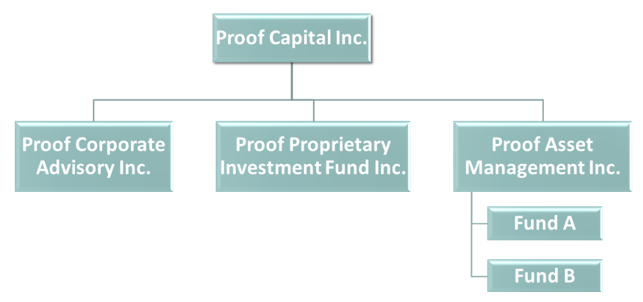
Proof Advisory, the PROP Fund, and their respective partners, directors, and officers (collectively the “Access Person[s]”) are also engaged in a variety of management, advisory, and other portfolio management and financial planning activities which may not involve an investment in the Fund. Proof Advisory may earn advisory fees from performing due diligence and structuring securities in which the Manager may or may not direct the Fund to invest, and while the PROP Fund may invest in parallel with the Fund (see clause 10.6 below) it may also invest in opportunities in which the Fund either cannot or choses not to invest. As such, the Manager’s investment decisions for the Fund must be made independently of all Access Persons. Any related situations that result in a real or potential conflict of interest shall be referred to the Conflict Advisory Board (defined in clause 10.3 below).
The Chief Investment Officer of Proof and PAM is also an Advising Representative of the Manager.
10.3 Conflict Advisory Board: Proof has established an advisory board to provide recommendations and advice to the Manager to address real or potential conflicts of interest in the best interests of investors in the Fund in compliance with all applicable laws and best practices (“Conflict Advisory Board”). The Conflict Advisory Board will include qualified individuals independent from Proof. The identities of the members of the Conflict Advisory Board at any given time shall be publicly disclosed on Proof’s website (www.proofcapital.ca).
10.4 Proof Corporate Advisory: Proof Advisory clients include both public and private entities (“Advisory Clients”). Proof Advisory analyses the risks and opportunities of Advisory Clients, develops structures and terms for potential financing solutions, develops strategic alternatives, and recommends and introduces potential capital providers. Proof’s family of funds is a potential funding source for Advisory Clients, and the Manager may, from time to time and as it deems appropriate, invest solely or with other investors in these opportunities. The Manager has a potential conflict of interest when Proof’s funds invest in the securities of any entity to which its subsidiary, Proof Advisory, is also providing advisory or underwriting services which earn fees for Proof Advisory.
To address the potential fee conflict caused by Proof Advisory receiving fees related to the Fund’s investments, Proof Advisory shall seek to align its interests with the interests of investors in the Fund by receiving advisory and/or underwriting fees in at least one of the two following manners:
- Payment of least 50% of advisory or underwriting fees shall be received “in kind” in securities of the issuer;
- Fees shall be received in the form of a carried interest that is earned after the Fund receives at least a 100% return of invested capital.
The Manager shall also promptly notify the Conflict Advisory Board of any such situations. The Manager shall also provide the Conflict Advisory Board with sufficient information to provide considered advice on the matter, and give full and sufficient consideration to the Conflict Advisory Board’s recommendations on potential investments where a potential conflict of interest exists, taking care to adopt recommendations the Conflict Advisory Board believes are sufficient to ensure the conflict has been adequately addressed in the interests of investors in the Fund. Proof Advisory shall not accept advisory or underwriting fees in a manner different than the two methods described above without the approval of the Conflict Advisory Board.
10.5 Directorships: A potential conflict of interest may arise if an Access Person accepts a directorship in an entity in which the Fund has invested or in which the Manager is considering an investment. This is a potential conflict of interest because the Access Person’s fiduciary duty as a director (to the 3rd party entity) could potentially come into conflict with its fiduciary duty to the Fund.
The Manager shall promptly notify the Conflict Advisory Board of such directorships. The Manager shall also provide the Conflict Advisory Board with sufficient information to provide considered advice on any such matter , and give full and sufficient consideration to the Conflict Advisory Board’s recommendations on potential investments where a potential conflict of interest exists, taking care to adopt recommendations the Conflict Advisory Board believes are sufficient to ensure the conflict has been adequately addressed in the interests of investors in the Fund. If the conflict cannot be adequately addressed by any other means, then the access person shall recuse himself from the directorship. In addition, the Manager shall adopt the following disclosure policy:
- Posting and maintaining a list of all directorships on Proof’s website (proofcapital.ca);
- Providing this list to the client at the time of account opening, and directing them to the location where it can be accessed at anytime;
- Directing all unit holders to the location of the list (and highlighting any changes) at least once per quarter.
10.6 Parallel Investments: The Manager acknowledges that Access Persons making a parallel investment along side the Fund could be a potential conflict of interest if the allotment of such investments is not equitably distributed. To address this potential conflict, when the Fund and one or more Access Persons are engaged in the purchase or sale of the same security, such parallel investments shall be allocated and disposed of in a fair and equitable basis (and with full consideration to the advice of the Conflict Advisory Board). The Manager’s investment decisions for the Fund shall be made independently of those made by any and all Access Persons.
10.7 Self Dealing: The Manager acknowledges that a conflict of interest could develop any time the Fund purchases a security from, or sells a security to, the PROP Fund or any Access Person.
To address this potential conflict of interest, any trades between the Fund and an Access Person will only be permitted if the trading price is validated by a third party transaction of comparable size (such as a coincident, broadly distributed equity financing by the issuer). Furthermore, neither the Prop Fund nor any single Access Person shall be permitted to buy securities from or sell securities to the Fund if the Prop Fund or Access Person owns more than 10% of the issuer’s outstanding securities, or if all Access Persons combined own more than 50% of the issuer’s outstanding securities.
In addition, neither the PROP Fund nor any Access Person shall be permitted to purchase a security from, or sell a security to, the Fund without first addressing the potential trade with the Conflict Advisory Board. The Manager will provide the Conflict Advisory Board with sufficient information to provide considered advice on any such matter, and will give full and sufficient consideration to the Conflict Advisory Board’s recommendations on potential investments where a potential conflict of interest exists, taking care to adopt recommendations the Conflict Advisory Board believes are sufficient to ensure the conflict has been adequately addressed in the to address the interests of investors in the Fund. If the conflict cannot be adequately addressed, then the trade will not be permitted.
The Manager shall also adopt the following disclosure policy:
- Posting and maintaining a list of all the holdings of the PROP Fund on Proof’s website (proofcapital.ca);
- Providing this list to investors in the Fund and obtaining written consent for such potential transaction at the time of account opening, and directing them to the location where it can be accessed at anytime;
- Directing all unit holders to the location of the list (and highlighting any changes) at least once per quarter.
10.8 Proprietary Products: The Manager acknowledges that a conflict of interest could be created if both Proof proprietary products and non-proprietary products are sold to investors, and if the proprietary products have higher sales commissions attached to them than the non-proprietary products. Proof shall avoid this potential conflict by adopting the policy of attaching the same sales commissions to all products sold to investors, regardless of whether on not the products are proprietary or non-proprietary. In addition, Proof notes that the name of its firm and the name of its proprietary investment products have intentionally been made sufficiently similar such that further disclosure is not necessary to affirm that all of Proof’s Funds are proprietary.
10.9 Process for Unforeseen Conflicts of Interest: If an unforeseen potential conflict is identified, the Manager shall seek advice from the Conflict Advisory Board. Potential conflicts which cannot be adequately addressed in the best interests of clients shall be avoided. In all cases, real and potential conflicts and the recommendations of the Conflict Advisory Board shall be documented and promptly reported to the Manager’s Chief Compliance Officer, whose independence and authority shall be respected by the Manager. In addition, not less than once annually the Manager, the Conflict Advisory Board, and the Chief Compliance Officer shall reassess the firm’s conflict management framework, and any recommendations for improvement shall be implemented.